Bruno’s Byte: “If attackers own identity, they don’t need to break everything, they can just make you unable to fix anything.”
In 2026, resilience conversations are finally landing where they should: identity. Because when Active Directory (AD) or Microsoft Entra ID gets compromised, the impact isn’t limited to logins, it can stall recovery across email, endpoints, apps, and even security tooling.
The key shift: identity resilience isn’t the same as identity security.
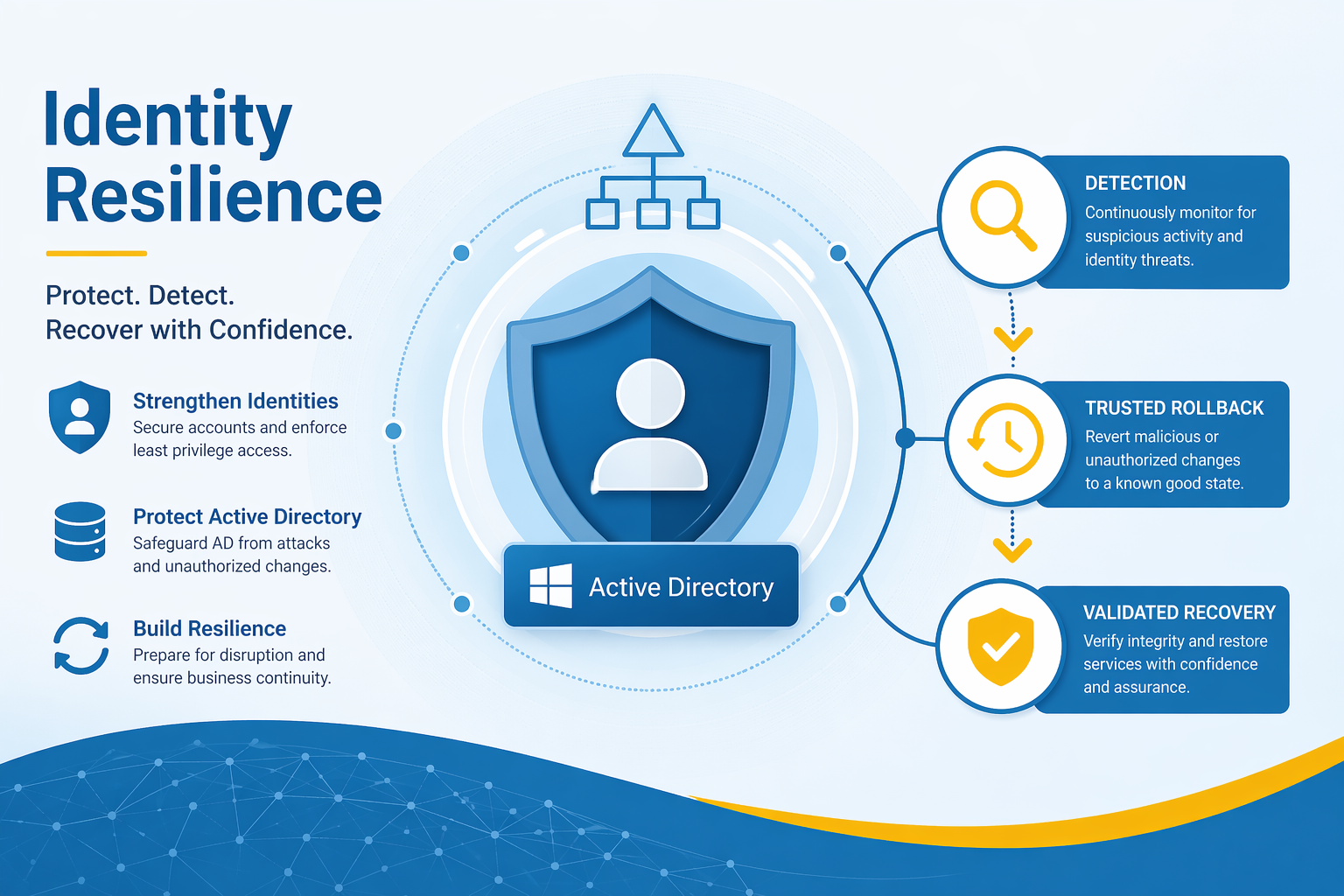
Security tries to prevent compromise. Resilience assumes compromise happens and focuses on restoring a trusted identity state—fast, repeatably, and with proof.
The Identity Failures That Break Recovery
Here’s what agencies often discover after the incident starts:
- “We backed up AD” doesn’t mean “we can recover AD.”
If you haven’t practiced forest recovery under pressure, you don’t know your actual RTO. - Modern attacks “poison” identity quietly.
Think: privileged group changes, new delegated admin paths, GPO manipulation, OAuth consent abuse, conditional access edits, stuff that can persist even after you clean endpoints. - Hybrid identity expands the blast radius.
AD + Entra synchronization means bad changes can travel, and recovery has to be coordinated across both planes. - Recovery slows down when privilege is chaotic.
During incidents, teams get stuck on: who’s allowed to do what, where break-glass accounts live, and what the “known-good” state actually is. - Audit readiness matters.
Increasingly, the question becomes: can you show what changed, what you restored, and how you validated it?
What “Good” Looks Like in 2026
A practical identity resilience approach usually includes:
- A known-good baseline (what “trusted” means for AD/Entra config, privileged groups, policies, and sync scope)
- Change visibility (what changed, when, and why it matters)
- Rollback capability (reverse malicious changes without always rebuilding everything)
- Orchestrated recovery (especially AD forest recovery—repeatable steps, fewer manual mistakes)
- Validation before reconnecting (don’t reintroduce a compromised identity plane back into production)
- Evidence artifacts (tests, logs, approvals, results)
Where the Vendors Are Heading (Concepts First, Names Second)
You’ll notice the market converging on the same idea: detection → trusted rollback → validated recovery.
- Commvault is emphasizing orchestrated AD recovery (including forest recovery automation) and tying identity recovery into broader cyber recovery workflows.
- Cohesity + Semperis are framing identity resilience as a hybrid AD + Entra problem, pairing attack visibility with recovery workflows.
- >Rubrik is leaning into closing the loop between identity threat detection (including Microsoft security signals) and rapid rollback/recovery.
Different approaches, same destination: restore trust, not just services.
A Quick Gut-Check for Federal Teams
If you can’t answer these confidently, identity resilience is a near-term priority:
- Can we restore AD/Entra to a known-good point in time?
- Can we reverse privileged changes quickly?
- Have we tested an AD forest recovery in the last 6–12 months?
- Do we have break-glass access that’s tested and protected?
- Can we prove the recovery steps and outcomes?
Closing Byte from Bruno
Bruno’s Byte: “In 2026, the fastest way to shorten downtime isn’t just better backups, it’s making identity recoverable, testable, and trustworthy.”